| ORMSware Queuing Networks-Structured Discrete Event Simulator |
ORMSware Discrete Event Simulator (not for sale) is a great tool for fast, easy, off-the-cuff visual logic programming that can be long-lasting due to its virtually physical paradigm and self-documenting nature. It is ideal for communicating quantitative business and engineering models as they are formulated in terms of probes/surrogates/entities traversing hierarchical queuing networks.
 |
Almost all of the content and control logic inside ORMSware network objects are common to all languages, such as if-then-else, do, and case constructs.
As far as variables go, it helps to know about data types, arrays, etc. Those who know something about derived types and other advanced concepts will be able to follow the nuts and bolts of ORMSware models. You will see this demonstrated when you go through the Examples.
ORMSware's logical networks-oriented language packs the power of modeling with an object-oriented tool while offering a short learning cycle. The power of ORMSware is its paradigm, not the compiler used to turn ORMSware models into executable machine language instructions.
Target Audience
Though ORMSware networks are easily understood by any stakeholder of a problem, nuts and bolts of advanced business and engineering formulations may be easier to understand for people with math/science/engineering/IT backgrounds.
People who are most likely to be attracted to ORMSware are power users who need large scale models for solving engineering problems and/or advanced scientific models for solving business problems in defense and aerospace sectors, and at universities and national labs. Organizations constrained by complex spreadsheets for supporting operations, who are actively looking for a lucid solution structuring environment, are also likely to be attracted to ORMSware.
Features
Features listed below should give you a good overall understanding of the nature of ORMSware.
Time tradeoff: The illustration at the beginning of this page shows relative advantages of ORMSware, higher order programming languages, and spreadsheet environments depending on the complexity and size of problems.
One of the reasons why implementing models in NMOD is much faster than developing code from scratch is that most of the basic and repetitive programming tasks are already built into NMOD. Another reason is that NMOD enables analysts to think more at problem level than at code level, in terms of physicality, time and motion.
Chunking, Ready-Shoot-Aim: As you may have read in In search of Excellence, people who get things done and get them done well tend to conquer complex problems using the "chunking" and "ready-shoot-aim" approach. With NMOD's paradigm and visual modeling interface it is easy to change and rewire a model to evolve towards the right solution as the analyst iteratively gains deeper understanding of a complex problem.
Structural strengths: Key strengths of logical network structures are their all-encompassing nature and lucidity. These strengths, combined with the fact that models are visual, help all stakeholders involved in solving a problem communicate quickly, easily, and accurately with each other about what is being modeled and how it is being modeled. Since ORMSware networks can be structured from logical and physical perspectives rather than just physical perspectives or just process perspectives, problem formulations can be at a higher, more flexible and powerful level of abstraction.
Compressing time: NMOD compresses the time necessary to take a model from inception to implementation as well as time required for model maintenance. It is ideal for modeling problems that are too complex for spreadsheets, especially when the problems are highly discipline-oriented. NMOD obviates the need for extensive and expensive programming support from IT professionals who may not have the subject matter expertise to comprehend the problem quickly enough to be productive.
Mitigating modeling risks: With NMOD, customers and management do not have to blindly trust black boxes developed by modeling and programming teams. From a reverse perspective, technical teams can bring their customers as deep inside the modeling world as they desire to enter, to scrutinize and understand the model without undue burden on either side. Such validation and verification capability closes common communication gaps, reducing risks of major errors in problem formulation and/or costly delays in solution implementation.
Creative uses of Events Queue and time dimension: Because ORMSware is discrete event simulator, analysts can leverage its time functions and events queuing capability to gain considerable modeling ease, flexibility and power. Several examples in this document take advantage of NMOD's Events queue. For example, in Example Problem 1, time attribute of Events queue is treated as cost attribute to automatically order solution alternatives from lowest to the highest cost.
 |
Hierarchical modeling: With NMOD's hierarchical modeling capability, a modeling team can rapidly put together cursory, high level models. As the team goes through each learning cycle with a model, [sub]networks with more details can be developed and referenced in higher level nodes. Analysts can prevent execution thread from traversing a [sub]network by simply changing the referencing node's Type property from Network to Normal or any other relevant Type.
Even when a node's Type property is Network, it still functions as a Normal node once execution control returns to it from the [sub]network it references. This is a useful feature for modeling large scale problems where model granularity can be controlled by simply changing the Type property of network reference nodes.
Any node in any network can reference any other network in a model. The number of nested [sub]network references is limited only by memory of the computer on which the model is running. Recursive referencing is totally within analyst's control and does not have to be declared explicitly.
Optimization through response surface search: NMOD is a descriptive (what-if) modeling tool. However, it does have certain prescriptive (normative/optimization/if-what) capabilities such as Golden Section and Fibonacci searches for one-dimensional optimization of real and integer control/design/decision variables, and successive bisection search for goal-seeking (see Example Problem 5: Transportation Fleet Flow - Optimal Fleet Size Size). A trivial looping procedure is also available for mindless searching for optimal answers. Though trivial, this procedure is handy for quickly demonstrating to concerned customers that answers found by non-naive optimization search procedures are indeed optimal.
Optimization through hierarchical-queuing-networks-structured modeling and programming: Example Problem 6: Transportation Costs From Distribution Centers To Stores shows how to develop optimization models with ORMSware. Another good example of normative/optimization modeling with ORMSware is a dynamic programming algorithm for solving Example Problem 1: Optimal Machine/Equipment Replacement Planning presented in a series of video briefings.
Spreadsheet to NMOD transition: Since moving a model from spreadsheet to NMOD is a simple, systematic process, it may be prudent to test a math/logical model in a spreadsheet during initial model development phase. If spreadsheet boundaries begin to hamper the effort as the model grows, development can be migrated to NMOD using our transformation methodology.
In many cases it may be obvious from the outset that spreadsheet will be a constraining environment for the problem at hand. In such cases it is better to go straight to NMOD. Spreadsheets and databases can still be part of the total solution to the problem as those environments are ideal for entering and maintaining elementary data, performing preliminary calculations, and displaying results.
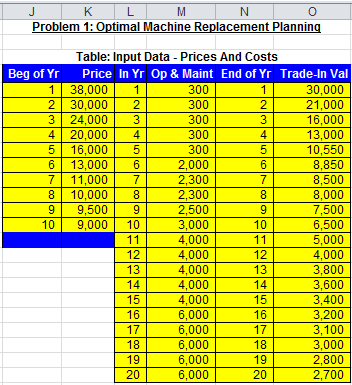 |
Integrated solutions: If a modeling effort in process has to be moved from spreadsheet to NMOD, most, if not all, tables can be kept in the spreadsheet (Excel) environment and referenced from NMOD.
Mixed language solutions: NMOD models can be linked dynamically and/or statically to Visual Basic, Visual C++ and Delphi code.
Independent execution: Unlike most modeling environments, every model developed with NMOD is a standalone program. Therefore, once a model is developed, it can be executed independently on machines that do not have installed copies of NMOD.
Model scalability and portability across platforms: NMOD translates logical networks built with ORMSware objects into code that can be executed on any platform, from PCs to supercomputers (certain processors required).
Control of memory allocation increments: ORMSware uses dynamic memory allocation for all arrays that need to be expanded during execution. Expansion increments for key arrays are within the control of analysts so that we can take advantage of potential opportunities to optimize execution of large scale models. This may not be a significant feature in most cases, but it is there in case it makes a difference.
Some of the examples included in this document are small and simple. They are scaled-down, simplified versions of real problems, but they do help readers gain quick understanding of the nature and capabilities of NMOD.
It is our hope that the range of examples included here is sufficient to stimulate readers to think of their modeling challenges. If you have any scaled-down examples of real problems that will be ideal for extending the range demonstrated here, please contact us.
At least three of the examples included here can be programmed fairly easily using any higher order language (HOL), especially if the language has good intrinsic array/matrix functions and procedures. However, as these models grow to become more comprehensive, NMOD will do better in terms of total cycle time, more learning cycles during each project for creating better problem comprehension, and much better model clarity and reliability.
We recommend that you go through these problems in sequence, since explanations in some parts of a problem may refer to concepts introduced in previous problems.
Before you look at NMOD model formulation of each problem, it may also be helpful to take a little time to reflect on, and perhaps sketch out how that problem would be modeled with Microsoft Excel or other familiar modeling tools.